
Clinical work doesn't end when a patient visit does.
Solafya tracks every lab order, identifies unfulfilled follow-ups, and surfaces chart-aware clinical context before patients fall through the cracks.
Clinical work doesn't end when a patient leaves the exam room.
Physicians spend nearly half their office day, 49.2 percent, on EHR and desk work: chart review, inbox management, and unresolved orders.1 Solafya automates the part of that load that closes the loop on lab follow-up.
1. Sinsky C, et al. Allocation of Physician Time in Ambulatory Practice: A Time and Motion Study in 4 Specialties. Annals of Internal Medicine, 2016;165:753-760.
How many abnormal results have no documented follow-up?
Share a secure copy of your lab and visit data and we'll count them for you, free, under a BAA. No integration needed.
See how the free audit worksEstimate the time
Estimate the staff time lab follow-up takes
Enter your practice's numbers to estimate how many staff hours a closed-loop lab follow-up workflow could free up. The defaults are illustrative assumptions you can change.
Estimated staff hours recovered
1,000 hours / year
About 20.0 staff hours per week
- Estimated current staff workload
- 50.0 staff hours / week
- Time your staff spend tracking lab results today, based on your inputs.
- Potential reduction in tracking time
- 40%
- Your assumption, not a measured result.
- Estimated annual labor capacity value
- $28,000 / year
- Staff time that could be redirected to other work. It is not cash savings or reduced payroll.
Replace these estimates with your own lab follow-up numbers.
How this is calculated
- 15 clinicians × 50 results per week × 4 minutes ÷ 60 = 50.0 staff hours per week of tracking today
- × 40% potential reduction = 20.0 staff hours per week recovered
- × 50 operating weeks = 1,000 staff hours per year recovered
- × $28 per hour = $28,000 per year of staff labor capacity
These estimates are based on your inputs and are not guaranteed savings. A workflow assessment can help establish your current lab follow-up burden and refine the assumptions. The $28 hourly figure is an illustrative loaded staff cost, informed by U.S. Bureau of Labor Statistics wage data for medical assistants plus payroll-tax and benefits loading. Published time-motion research (Sinsky et al., Annals of Internal Medicine, 2016; Arndt et al., Annals of Family Medicine, 2017) shows that results management is a substantial part of ambulatory work, but it does not validate these specific figures.
The five-step loop
How Solafya closes the loop
The loop starts before the result, at the moment a lab is ordered.
Patient encounter
ClinicScribe captures spoken lab intent during the visit.
Order tracking
Orders placed in athenaOne are tracked until a result comes back.
Continuous tracking
LabWatch monitors incoming results against the patient's history.
Lumina chart synthesis
Contextual risk scoring and guideline-backed differential reasoning.
Resolution
Pre-drafted note ready for one review and sign-off.
The clinical intelligence layer
Lumina AI: clinical & operational intelligence
Not just another AI copilot. Lumina is the chart-aware intelligence engine that powers LabWatch and ClinicScribe: synthesizing patient history for physicians and triaging risk for care teams.
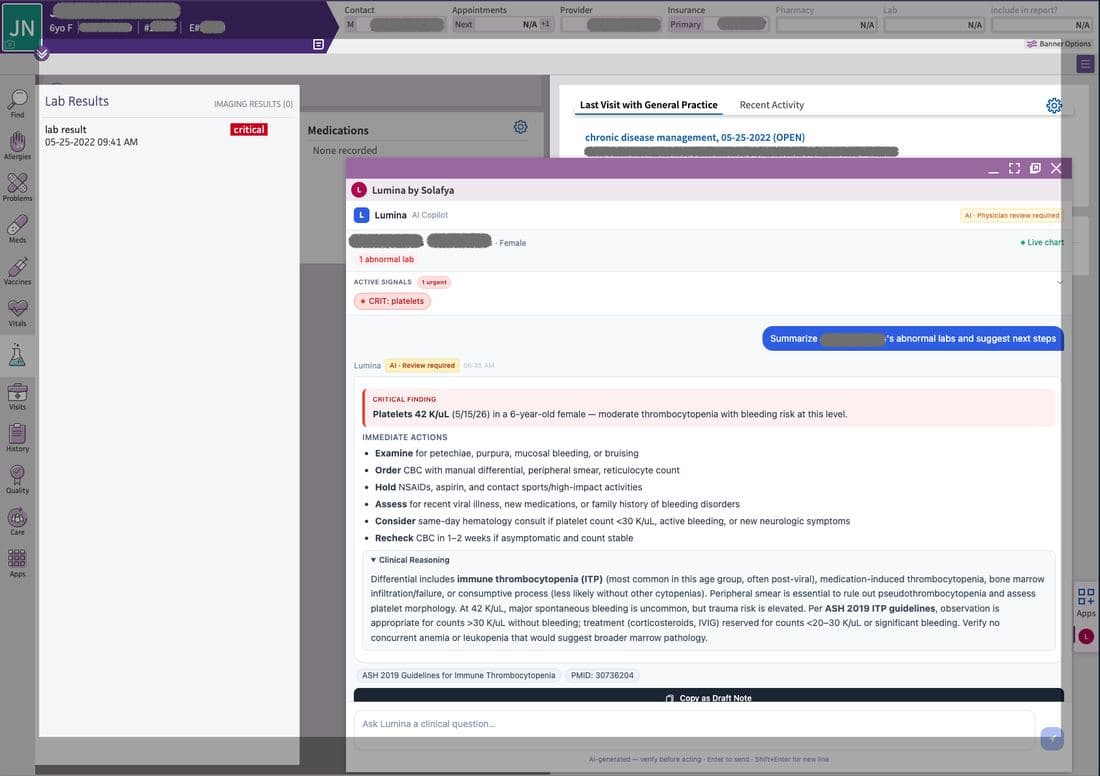
Shown in the athenahealth Preview Environment. Hypothetical case; the patient is not real. We never use real patient information in our marketing, and we never share yours outside your clinic.
For clinicians, at the point of care
Chart synthesis
Reviews lab trends, medications, and diagnoses in seconds.
Trend detection
Flags worsening lab trends, like Platelets 42 K/uL in a 6-year-old female, before they become acute.
Guideline-backed next steps
Cites published literature, including PubMed PMID references, for one-click drafting and physician review.
For practice operations, across the group
Risk prioritization
Surfaces the highest-risk patients with unresolved lab orders.
Operational bottlenecks
Identifies pending follow-ups before they stall.
Closed-loop audit
Tracks every abnormal result to a documented resolution.
Interoperability
Built to work with your EHR. Starting with athenaOne.
Solafya supports EHR-connected clinical workflows, with athenaOne as our initial integration. Additional EHR integrations are in development.
athenaOne
Implemented and tested in athenahealth's Preview Environment. Not yet in production use.
Each integration is at its own stage. Solafya is designed to work with the systems your practice already uses.
Can Solafya work with my EHR?
LabWatch is built to integrate with existing EHR workflows, starting with athenaOne. We’re currently onboarding our first clinical pilot practices, with additional EHR integrations planned.
If you’re interested in joining our founding pilot program, we’ll review your EHR setup together and confirm the integration steps before getting started.
Alerts that arrive in time.
Every critical result, worsening trend, and stalled follow-up reaches the right person. Alerts say what needs attention and how urgent it is; the patient details stay behind your sign-in.
From: Solafya Alerts <noreply@notifications.solafya.com>
🔴 Solafya CRITICAL alert: a lab result needs your review
Hello Dr. Iyer, a critical lab result needs your review.
- Urgency:
- CRITICAL
- Respond by:
- 10:02 AM, today
The email says what needs attention and how urgent it is. It contains no patient name, ID, lab value or diagnosis. Details are shown after you sign in.
Hypothetical case. Patient is not real.
Critical lab: pushed to phone
Sent to the on-call physician
No patient details in the text. The patient, the result, and the recommended action stay behind login.
Hypothetical case. Patient is not real.
Worsening renal function detected
Patient: S.M., 45F
Slope: -5.7 mL/min/month. Crossing CKD Stage 3a → 3b threshold.
Lumina recommends: Nephrology consult within 30 days. Repeat creatinine + urine ACR. Review for nephrotoxic medications (NSAIDs, contrast exposure).
AI-generated insight. Physician review required.
Hypothetical case. Patient is not real.
No follow-up documented: 14 days
- Patient:
- M.K., 58M
- Lab:
- Hemoglobin 9.2 g/dL (low, anemia workup needed)
- Drawn:
- 14 days ago
- Ordering:
- Dr. Patel
Status: result reviewed but no follow-up plan documented.
Hypothetical case. Patient is not real.
These are example alerts using made-up patients. We never use real patient information in our marketing, and we never share yours outside your clinic. Email and text alerts carry no patient details.
Who it's for
Built for the people who run the practice, and the ones who treat the patient
Practice Managers
Own the operational risk when a result falls through the cracks, without adding headcount to manage it.
Practice Administrators
Need staff time back from manually chasing labs across spreadsheets and systems.
Directors of Clinical Operations
Accountable for follow-up compliance, without an audit trail that proves it.
Physicians
Carry the liability when a result is missed, and the burnout of chasing it themselves.
The lab follow-up gap
In busy independent clinics, abnormal lab results move through multiple steps:
Ordering
Result review
Patient notification
Follow-up scheduling
When staff are overloaded, follow-up responsibility becomes unclear. Manual systems break under pressure.
Missed or delayed follow-up increases clinical risk and liability exposure.
Built for independent medical groups
Physician-owned medical groups running on athenaOne, typically 10 to 50 clinicians, without hospital-scale care coordination infrastructure.
LabWatch enhances clinical judgment. It does not replace it.
Designed specifically for:
Enterprise credibility & governance
 Dr. Michael Merjanian, MDEmergency Medicine, Los Angeles CA
 Dr. Aws Al-Abdullah, MDEmergency Medicine, Scottsdale AZ
Tested before go-live
Our athenaOne integration is implemented and has been tested in athenahealth's Preview Environment. Go-live for any practice follows athenahealth's authorization and validation steps.
Practicing physician clinical advisors
Developed with input from practicing physician clinical advisors. Our current advisors are Emergency Medicine physicians.
HIPAA-aligned, BAA-ready architecture
Patient data encrypted in transit and at rest. Never sent to ChatGPT or other public AI tools.
athenaOne Founding Clinical Partner Program
14-day evaluation. Then a paid founding pilot.
We're recruiting our first three clinical pilot partners: independent medical groups with 10 to 50 clinicians, starting with practices on athenaOne. Evaluate LabWatch for 14 days once your practice is ready to use it. If it's a fit, continue with a paid founding pilot under agreed terms. Our first three founding partners also receive three complimentary months toward a subsequent annual subscription.
Three founding partner spots available. Qualifying founding partners receive three complimentary months credited toward a subsequent annual subscription.
Apply for a founding partner spotBehind the workflow system
Solafya clinical intelligence platform
LabWatch is powered by a clinical intelligence system that prioritizes risk and reduces noise, without removing human oversight.
Tracks ordered labs through to a result
Real-time abnormal detection
Lab trend detection
Risk prioritization
Follow-up recommendations
Chart review summarization
AI suggests. Clinicians decide.