One intelligent platform. Two closed-loop workflows.
LabWatch tracks every important lab follow-up, not just the result. It catches when a clinician means to order a lab but the order never makes it into athenaOne, tracks every abnormal result to a named owner, and confirms resolution before the loop closes.
Request pilot consultation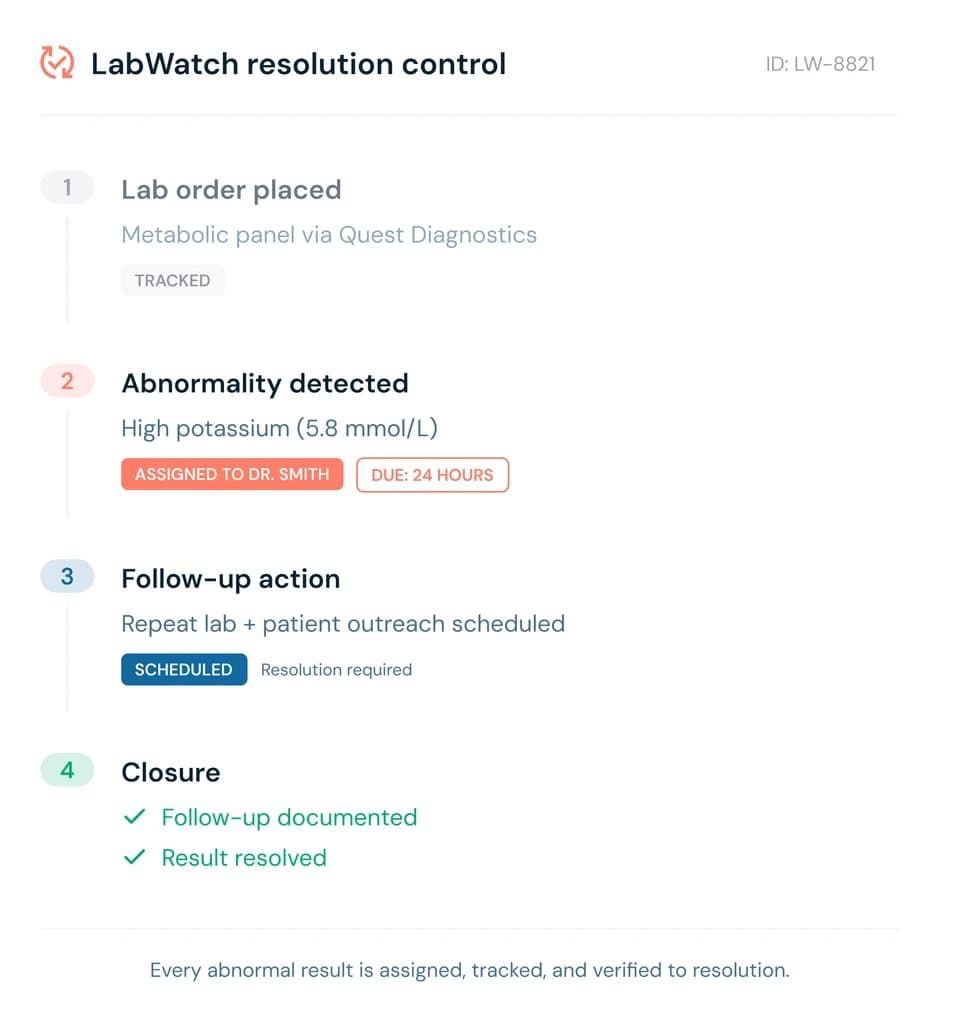
One pipeline, not two products
ClinicScribe and LabWatch run as a single system
Encounter intent
ClinicScribe
Hears when a lab is mentioned during the visit.
Order tracking
athenaOne orders
Orders are tracked from placement until a result returns.
Risk & trend engine
LabWatch
Incoming results evaluated against the patient's lab history.
Pre-drafted resolution
Clinician review
A follow-up draft ready for one review, edit, and approve.
Built to work with your EHR, starting with athenaOne. Designed to fit the workflow your team already uses.
AI Suggests. Clinicians Decide.
LabWatch: complete lab follow-up workflow
LabWatch is not a dashboard. It is a closed-loop lab workflow system embedded directly into your clinical operations. It ensures no abnormal result is left unresolved.
Captures every lab order across your EHR
Identifies abnormal results
Tracks follow-up ownership
Monitors resolution
Maintains audit trail
Built. Integrated with LabWatch.
Powered by Lumina AIClinicScribe hears the lab. LabWatch makes sure it happens.
Ambient documentation is the easy part. When a lab is mentioned during the visit, ClinicScribe captures it for clinician approval and LabWatch tracks it through to a result, so a lab that gets mentioned doesn't just disappear.
In the room
“...let's get a BMP before we adjust his lisinopril...”
ClinicScribe captures the intent
Lab order intent recorded for clinician approval: Basic Metabolic Panel before adjusting lisinopril.
LabWatch tracks it to completion
Tracked as a follow-up with a deadline. If a placed order never produces a result, it is flagged to staff, not discovered three weeks later.
Ambient documentation, drafted for physician sign-off
Lab intent from the visit tracked through to a result
Drafts paperwork, never a diagnosis. Always reviewed by a clinician.
Estimate the time
Estimate the staff time lab follow-up takes
Enter your practice's numbers to estimate how many staff hours a closed-loop lab follow-up workflow could free up. The defaults are illustrative assumptions you can change.
Estimated staff hours recovered
1,000 hours / year
About 20.0 staff hours per week
- Estimated current staff workload
- 50.0 staff hours / week
- Time your staff spend tracking lab results today, based on your inputs.
- Potential reduction in tracking time
- 40%
- Your assumption, not a measured result.
- Estimated annual labor capacity value
- $28,000 / year
- Staff time that could be redirected to other work. It is not cash savings or reduced payroll.
Replace these estimates with your own lab follow-up numbers.
How this is calculated
- 15 clinicians × 50 results per week × 4 minutes ÷ 60 = 50.0 staff hours per week of tracking today
- × 40% potential reduction = 20.0 staff hours per week recovered
- × 50 operating weeks = 1,000 staff hours per year recovered
- × $28 per hour = $28,000 per year of staff labor capacity
These estimates are based on your inputs and are not guaranteed savings. A workflow assessment can help establish your current lab follow-up burden and refine the assumptions. The $28 hourly figure is an illustrative loaded staff cost, informed by U.S. Bureau of Labor Statistics wage data for medical assistants plus payroll-tax and benefits loading. Published time-motion research (Sinsky et al., Annals of Internal Medicine, 2016; Arndt et al., Annals of Family Medicine, 2017) shows that results management is a substantial part of ambulatory work, but it does not validate these specific figures.
Why this matters
Independent clinics process hundreds to thousands of labs each month.
Without structured oversight:
Results get delayed
Responsibility becomes unclear
Follow-up falls through workflow gaps
LabWatch provides consistent oversight that scales with your clinic, without adding administrative burden.
Intelligent engine behind LabWatch
Solafya's clinical intelligence engine, branded Lumina where it surfaces inside your EHR, watches for risk and prioritizes follow-up. It picks up when ClinicScribe captures a clinician-approved lab intent, or the moment a result comes back.
Early warning detection
Risk scoring
AI-assisted follow-up recommendations
Summarized clinical context
AI suggests. Clinicians decide.
An athenaOne integration, implemented and tested in athenahealth's Preview Environment, with Epic and Oracle Health (Cerner) connectors in development. Built on FHIR R4, the standard healthcare data format, so it fits the way your IT team already connects systems.
One case, from the visit to resolution
ClinicScribe: ambient visit transcript“...let's get a BMP before we adjust his lisinopril...”Intent detected: Basic Metabolic PanelNext: Tracked as a follow-up until a result arrives
Illustrative example. The patient is not real.
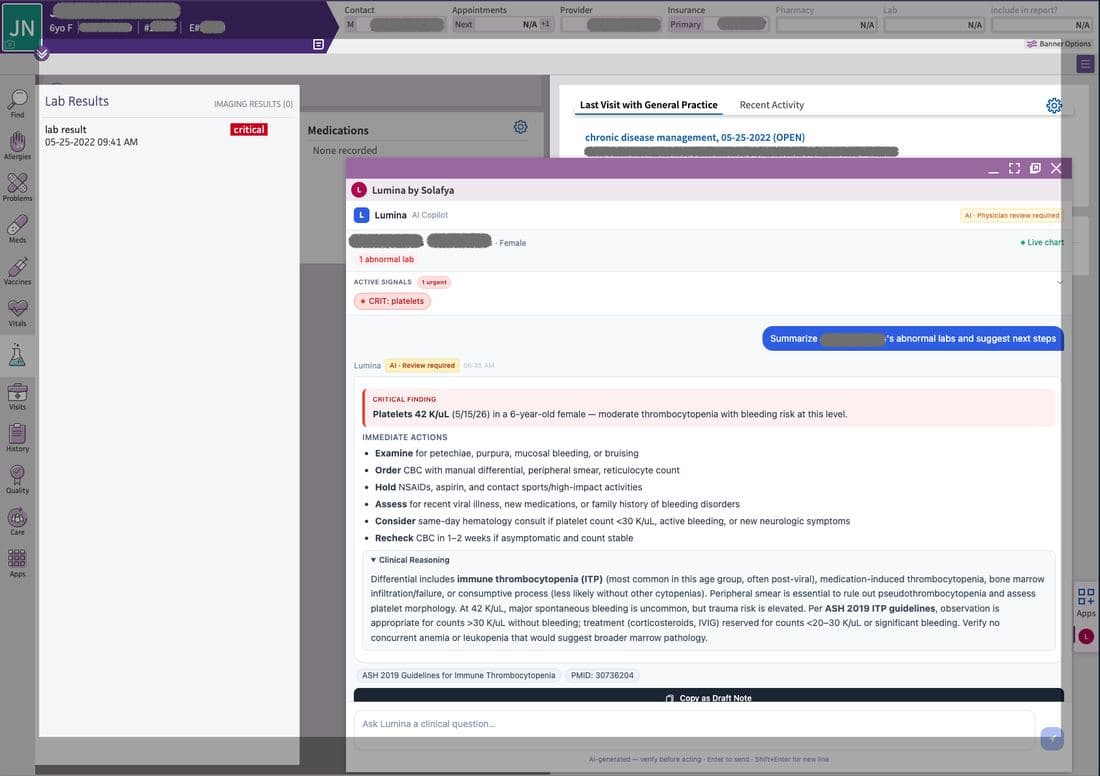
Designed for the workflow your team already uses.
Lumina is designed to surface inside the EHR, so critical findings show up where your team already works. Shown here in the athenahealth Preview Environment.
Why LabWatch is different
Most tools solve one piece of this. LabWatch closes the whole loop.
Ambient scribes stop at documentation. Alert tools stop at notification. LabWatch is the only system that follows one episode all the way through: from what was said in the room to a confirmed resolution.
Most tools in this space
Ambient scribes document the visit, then stop.
Alert tools flag an abnormal result with no idea what happened in the room.
Notifications pile up in a queue that belongs to no one.
LabWatch
Tracks every athenaOne order from placement until a result comes back.
Ties every result back to the visit that ordered it.
Assigns a named owner and a deadline, and confirms it's closed.
Want to see this in your EHR?
Request a 20-minute live walkthrough with the team.
Request a walkthrough